

Window of Opportunity Grant Project

New Hope Elementary
1900 New Hope Church Road, Chapel Hill, NC
Orange County
Project: Growing a School Community Garden
Application Request/Project Summary:
New Hope Elementary School
Project: Growing a School Community Garden
Narrative / Scope of Work
New Hope Elernentary School is a Title 1 Community School and Dual Language lmmersion School in the Orange County Schools system. We have a garden team, consisting of "core four" staff members, as well as multiple family and community partners. The "core four" have taken NCSU's School Gardens online course in order to support implementation of a school garden that when completed, will include a sensory garden, a pollinator garden, a vegetable garden, and an azalea garden.
We are thinking about our gardens through multiple lenses. On the garden team, two of our "core four" are focused on instructional outcomes - what students gain from their experiences learning in the garden. The other two members of our garden team include our school counselor and our community schools coordinator. They are working to build a space that feeds our school community, both literally and figuratively.
We’ve utilized the gardens in multiple ways already. Just last year, the following projects enriched and supported grade-level standards across content areas and grade levels:
-
Fifth graders participated in a bioblitz and created a New Hope Field Guide to teach others about the plants and animals found on our campus.
-
Fourth graders worked with area and perimeter to plan the garden space and then shared their ideas with the garden team.
-
Third graders built bug hotels to provide an overwintering habitat for ground-dwelling insects.
-
Second graders built a whirligig park (using pinwheels and tomato cages), learning about force and motion and sharing their learning with the school community.
-
First graders planted seeds and tracked their growth.
-
Kindergarteners learned about birds that live near New Hope Elementary School.
This fall, staff, volunteers, and families harvested from the garden and shared produce with more than 100 families through food pickup and deliveries.
If our Windows of Opportunity project proposal is awarded, we can continue to grow the gardens with and for our students and families in ways not yet realized. Some of our future dreams include:
-
Continuing to build interdisciplinary, project-based units that incorporate experiential and service-based learning for all students.
-
Incorporating the garden space into our monthly Exploration Days, focused on enrichment opportunities for all students.
-
Building systems to support a community garden that families can access during open hours. We are planning to begin this work this summer and continue throughout the year.
-
Working with students and families to enhance the pollinator garden so that we can become certified as a NWF Schoolyard Habitat.
Complete Timeline (Spring 2025–Fall 2026)
In the spring, we began installation of the pollinator garden with plant donations and support from community partners. This summer, we prepared the vegetable garden, which includes eight short garden beds, two long rows, and perimeter beds for berries. This area is fenced to keep deer out, and we will add shade covers to keep plants cooler during the warmer months. This fall, we began growing cold-tolerant vegetables and planted strawberries in the vegetable garden. We also installed the azalea garden, which includes azaleas awarded through KNCB's Annual Azalea Celebration this fall. Additionally, we began a partnership with Orange County Solid Waste & Recycling, which is supporting both our understanding of and funding for the implementation of a composting program through Compost Now.
Plans for this spring include multiple projects, which would be funded through our Windows of Opportunity proposal.
In the vegetable garden, we would like to add several blueberry bushes and thornless blackberry canes.
-
We would like to purchase multiple keystone species for the pollinator garden, including but not limited to: goldenrods, rudbeckia, asters, common boneset, Joe Pye weed, mountain mint, bee balm, golden alexander, milkweeds, switchgrass, little bluestem, and pink muhly grass. We will also add bird baths, nesting boxes, and nesting materials near the pollinator garden, and apply to become a Schoolyard Wildlife Habitat through the National Wildlife Federation.
-
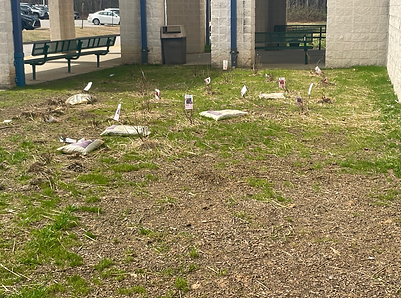
A new addition to our outdoor learning space is the sensory garden. Edible flowers and herbs will be planted in this section. The sensory garden will be located between the pollinator and vegetable gardens. Please see the images below for our design and plant ideas.
Project Site Photos
KNCB Visit / Pre-project


Project Site Area



Project Development
Project Development Photos Coming
Soon...
Project Completion Photos
Project Completion Photos Coming
Soon...